The usual advice for a symptom diary is to write down everything. People who have tried know how that ends: after two weeks the diary feels like homework, and it stops. In communities for people with long-term illness, the advice from those who kept going is the opposite: track only what matters to you. This guide helps you decide what that is.
Start with the question
A diary is easier to keep when you know what you want from it. Common questions are:
- How often does this really happen?
- Is it getting better or worse?
- Did the new medicine change anything?
- Does it come at certain times, or after certain things?
- What do I want to tell the doctor next month?
Pick one or two. They decide what goes into the diary, and everything that does not help answer them can stay out.
What to track
- Your main symptoms, one to three of them. The ones that trouble you most, or the ones your doctor asked about.
- For each: when, how strong, how long. A date and time, a number from 0 to 10, and when it ended.
- Medicines. What you took for it and when, and whether your regular medicines were taken.
- Anything new. A symptom you have not had before deserves a line, even if it seems small.
- Readings, if you were asked for them. Temperature, blood pressure, weight or blood sugar, with the time.
What you can skip
- Symptoms that are always the same. If your hands are stiff every single morning, write that once at the top. A daily entry adds nothing.
- A full food diary. Unless a doctor or dietitian asked for one, it is a great deal of work for little use. A tick for "skipped a meal" does more.
- Mood, sleep, water, steps and weather, all at once. Each one sounds useful. Together they are the reason diaries are dropped. Add one of them if your question needs it.
- Long descriptions. A few words are enough. Nobody will read paragraphs, and you will not write them on a bad day.
What about ordinary days?
You do not need an entry for every day. But a diary with only bad days cannot tell a good day from a forgotten one, so a single mark for "nothing today" is worth making. See why it helps to mark the good days.
Review the list every month
Once a month, look at what you are tracking and ask of each item: did I use this? If something was filled in for four weeks and told you nothing, drop it. If a new question has come up, add one thing. A diary may change with you.
How Pain Tracker does it
Pain Tracker, the Family Health app, starts with three symptoms as one-tap buttons, Headache, Migraine and Pain, and lets you add any symptom of your own. Each one gets its own journal with the days, the strength and the length. Medicines are ticked as taken, and readings such as temperature and blood pressure sit beside the symptoms in the doctor summary. There is no daily questionnaire.
Coming in version 2.0. The screens below are from version 2.0, which is on its way to the App Store. Update the app once it appears.
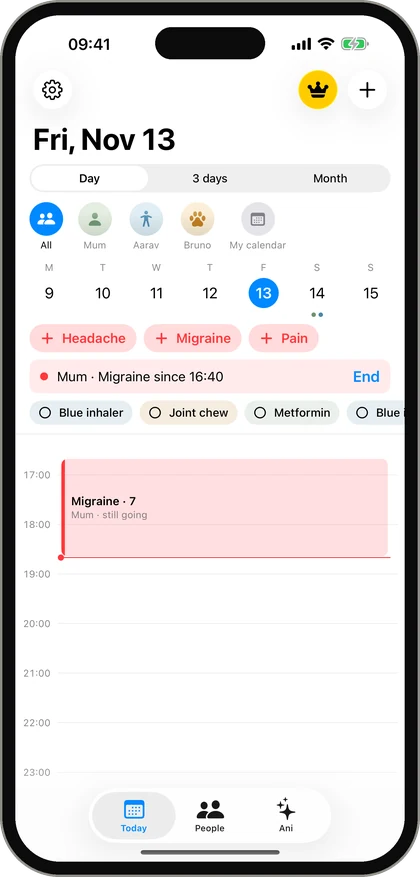
Pain Tracker keeps a record. It does not diagnose. For the basics of a pain diary, read how to keep one you will actually keep.
Questions people ask
What should I track in a symptom diary?
Track the one to three symptoms that trouble you most or that your doctor asked about, each with a date, a strength and a length. Add medicines taken and anything new or unusual.
Do I have to write in a symptom diary every day?
No. Many people only record days when something happened, plus a simple mark on days when nothing did. That keeps the diary light and still lets you count.
How many symptoms should I track?
As few as answer your question. One to three is a good start. A diary with ten symptoms a day is usually given up within weeks.
How do I keep a symptom diary for several conditions?
Give each symptom its own name and record them separately, so that each can be counted on its own. Bring one summary per symptom to the appointment.
This article is general information about keeping a record. It is not medical advice and does not replace your doctor. If your pain is new, sudden, severe or changing, see a doctor; in an emergency call your local emergency number.