Most pain diaries are lists of bad days. That seems natural: pain is what there is to write about. But one person in a chronic pain community suggested the opposite, saying that days without pain were so rare for them that those would be the more interesting ones to track. There is a good case for recording both, and it takes one second a day.
The empty-day problem
Look at a diary that only holds bad days. The 4th has an entry, the 9th has an entry, and the days between are empty. Were those four days free of pain, or were they days on which you were too unwell or too busy to write? Three weeks later you will not know, and neither will your doctor.
That matters, because the first number most doctors want is how many days in the month had pain. If empty days can mean either thing, that number cannot be trusted. A mark on good days closes the gap: every day is now a pain day, a good day, or a day that was truly not recorded.
How to record a good day
- A single mark. A tick, a dot on the calendar, the word "good". Nothing more is needed.
- In the evening. A day can only be called good once it is over.
- Optional: one word on what was different. Slept well, day off, did less. Only if something stands out.
Do not turn good days into a questionnaire. The point of a good day is not to spend it on a diary.
If you are never pain-free
For many people with long-term pain there are no days at 0. Then mark the better days: the ones at or below your usual level. "Good" means good for you. Our guide on usual pain and flare-ups explains how to write your usual level down.
What good days show after a month
- The real count. "11 pain days, 17 good days, 2 not recorded" is a firm answer.
- The change. Good days going from 12 to 17 after a new treatment says more than a feeling of "a bit better".
- Runs. Five good days in a row, or never more than two, are different lives with the same monthly total.
- What they have in common. If your one-word notes repeat, that is worth mentioning to your doctor. It is a thing to mention, not a proof.
There is a quieter reason too. A diary of nothing but bad days is heavy to read. Seeing the good days written down keeps the record true in both directions.
How Pain Tracker does it
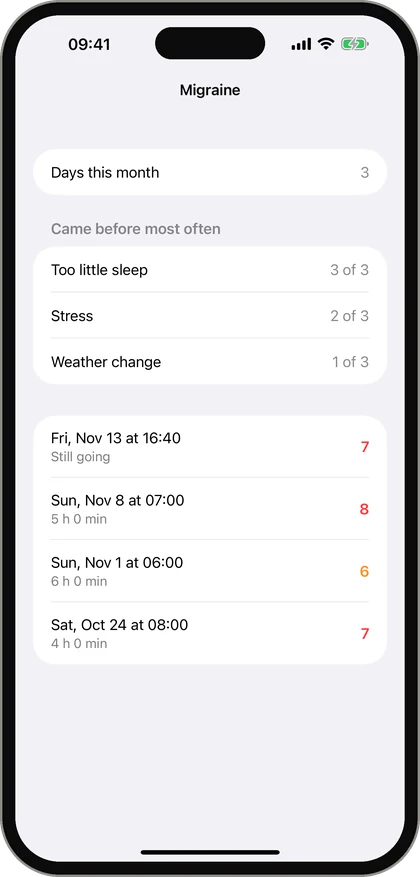
In Pain Tracker, the Family Health app, the calendar shows each day's entries, and the journal for a symptom counts the days it occurred this month. Days without an entry show as empty. The app does not yet have a one-tap mark for a good day; we are working on it for a coming version. Until then, a day without an entry counts as a good day, so it pays to log every pain day, even with one tap.
Coming in version 2.0. The screens below are from version 2.0, which is on its way to the App Store. Update the app once it appears.
For everything else that belongs in a diary, read how to keep a pain diary you will actually keep.
Questions people ask
Should I record days without pain?
Yes, with a single mark. It lets you count pain days correctly and tells a pain-free day apart from a day you forgot to write.
How do I count pain-free days in a month?
Count the days you marked as good. If you did not mark them, count the days without any entry, but be aware that some of those may be days you simply did not write.
What if I never have a day without pain?
Then record your better days: the days at or below your usual level. They show the same thing, and a short note on what was different can be useful.
Why do doctors ask about pain-free days?
The number of days with and without pain in a month is a simple way to see how much room pain takes in your life, and whether that is changing.
This article is general information about keeping a record. It is not medical advice and does not replace your doctor. If your pain is new, sudden, severe or changing, see a doctor; in an emergency call your local emergency number.