"On a scale from 0 to 10, how bad is your pain?" Almost everyone who sees a doctor about pain is asked this question, and many people find it hard to answer. This guide explains what the numbers usually mean, why a number on its own is often misread, and how to rate your pain so that your 6 today means the same as your 6 next month.
What the scale is
The 0 to 10 scale is the most common way of putting pain into a number. 0 means no pain at all. 10 means the worst pain you can imagine. You choose the number yourself; there is no test that can do it for you.
The numbers are commonly grouped like this:
- 0: no pain.
- 1 to 3, mild: you notice it, but you can carry on with what you are doing.
- 4 to 6, moderate: it is hard to ignore and gets in the way of work, chores or concentration.
- 7 to 10, severe: it takes over. You have to stop what you are doing, and at the top of the range you cannot do anything else.
Some clinics use slightly different words, and for young children there are scales with faces instead of numbers. The idea is the same.
Why a number alone is often misread
The scale has one weak point: nobody else can feel your 7. People who live with long-term pain often rate it lower than someone who rarely has pain would, because they are used to it. They also say that their number does not always land with the person asking. A number that seemed clear to you can sound like much less to the listener.
That does not make the scale useless. It means the number needs two things beside it: a fixed meaning for you, and a few words about what the pain did to your day.
Make your own key
Write down, once, what a few points on the scale mean in your life. For example:
- 2: I notice it when I sit still.
- 4: I can work, but I am slower and I need breaks.
- 6: I stop working and cancel plans.
- 8: I lie down in a dark room and cannot talk much.
- 10: the worst I have ever had; I needed urgent help.
Use this key every time you rate your pain. Now your numbers can be compared with each other, which is what makes them useful. You can also show the key to your doctor, so that they know what stands behind your 6.
Say what it stopped you doing
When you give a number, add what the pain stopped you doing. "It was a 7" says little. "It was a 7, I could not look at a screen and went home at noon" gives the listener a picture. Sleep, work, eating, walking and looking after children are the things doctors most often ask about, so those are good ones to mention.
Rate it at the time
Memory smooths pain. In the evening, a bad morning often feels less bad than it was, and after a week most people can only recall the worst day. A number written down while the pain is there is worth more than one rebuilt from memory.
If your pain changes during the day, you do not need a number every hour. The strongest point, the time, and how long it lasted are enough.
Keep the numbers in one place
A single number says how one moment was. A row of them shows whether things are changing: the usual strength over a month, how many days were 7 or more, and whether that was different after something new was tried. This is the part that helps most at an appointment. Our guide on keeping a pain diary shows how to collect them with little effort.
How Pain Tracker does it
In Pain Tracker, the Family Health app, every entry has a strength bar from 0 to 10 with a word beside the number: mild from 1 to 3, strong from 4 to 6 and severe from 7. The time is saved with it, so the rating is made at the moment, and the doctor summary works out the average strength for the last 7 days, 30 days or 3 months.
Coming in version 2.0. The screens below are from version 2.0, which is on its way to the App Store. Update the app once it appears.
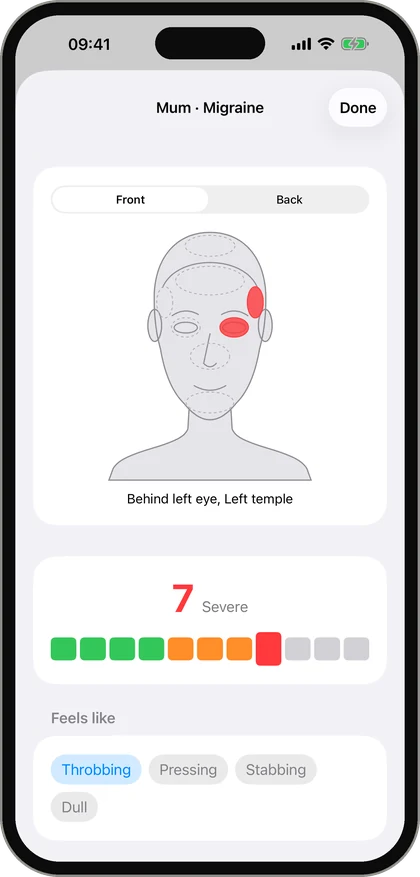
Pain Tracker keeps a record. It does not diagnose and it does not judge how much pain is "enough".
Questions people ask
What does the pain scale from 0 to 10 mean?
0 means no pain and 10 means the worst pain you can imagine. The numbers between are commonly grouped as mild (1 to 3), moderate (4 to 6) and severe (7 to 10). The number is your own rating, so it is most useful when you use it the same way every time.
Is a 7 on the pain scale severe?
In the common grouping, 7 to 10 counts as severe pain. What matters more to a doctor is what the pain stopped you doing, so say that along with the number.
Why do doctors ask for a pain number?
A number is quick to record and easy to compare over time. It shows whether your pain is getting stronger or weaker from one visit to the next, and whether something you tried made a difference.
How do I rate my pain when it changes during the day?
Write down the number at the time, not from memory in the evening. If you only make one entry, note the strongest point and how long it lasted.
This article is general information about keeping a record. It is not medical advice and does not replace your doctor. If your pain is new, sudden, severe or changing, see a doctor; in an emergency call your local emergency number.