A headache diary is a record of each headache: when it came, how long it stayed and what it was like. Doctors often ask for one, because how often headaches come and how many days a painkiller was taken are hard to remember correctly and matter a lot for what they do next. This guide shows what to write down, gives you a template to copy, and explains how to read the diary after a month.
What to write down for each headache
- Start. The date and the time, as closely as you know them.
- Length. When it ended, or how many hours it lasted.
- Strength. A number from 0 to 10. Our guide to the 0 to 10 pain scale explains how to use it the same way each time.
- Where. Forehead, one temple, behind one eye, the back of the head, the whole head.
- How it feels. Throbbing, pressing, stabbing or dull.
- What came with it. Feeling sick, light or noise hurting, seeing flickers or zigzag lines, dizziness.
- What you took or tried. The medicine and the time, or rest, water, a dark room, a cold pack.
- Whether it helped. A simple test is how you felt two hours later.
That list looks long. On a bad day, write only the first three and fill in the rest the next day.
A template you can copy
One line per headache is enough. On paper or in a notes app it can look like this:
- Mon 2 Nov, 07:00 · 5 hours · 7 · left temple, throbbing · light hurt · tablet at 07:30 · better after 2 hours: yes
- Sun 8 Nov, 16:40 · 3 hours · 4 · forehead, pressing · nothing else · rest, water · better after 2 hours: partly
Keep the order the same in every line. It makes the diary quick to write and quick to read.
Add what came before, as ticks
Many people keep a headache diary to find out what sets their headaches off. Choose a short list of things to tick, such as too little sleep, a skipped meal, stress, a long time at a screen, alcohol or a change in the weather, and tick what applied in the hours before.
Be careful how you read these ticks. They show what was often there before a headache. They do not prove a cause. Our guide on finding migraine triggers with a diary goes into this.
Count the days you took a painkiller
Write down every day on which you took something for a headache, even if it was a single tablet. The number of painkiller days in a month is one of the first things a headache doctor wants to know, and almost nobody can give it from memory.
Read it after a month
After four weeks, count:
- the days with a headache
- the usual length and the usual strength
- the place it most often was
- the days you took a painkiller, and how often it helped
- what you ticked most often before
Put these few numbers on one page and bring that page to your appointment. Keep the full diary with you in case the doctor asks about a single day.
How Pain Tracker does it
Pain Tracker, the Family Health app, is a headache diary that fills in the times for you. Tap Headache or Migraine when it starts and End when it is over. Mark the place on a picture of the head, set the strength, and tick how it feels, what came with it, what came before and what helped. The doctor summary does the counting: headache days, average strength and length, the usual place, painkiller days and how often relief followed within two hours.
Coming in version 2.0. The screens below are from version 2.0, which is on its way to the App Store. Update the app once it appears.
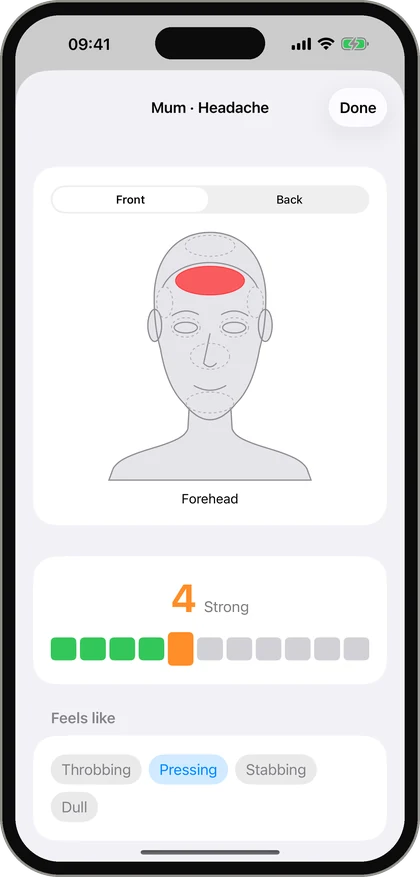
Pain Tracker keeps a record. It does not diagnose and it does not tell headache types apart.
Questions people ask
What should a headache diary include?
The date and time it started, how long it lasted, how strong it was from 0 to 10, where it hurt, what came with it, what you took or tried and whether it helped. Once the basics are a habit, add what happened before it started.
How long should I keep a headache diary?
Four weeks shows how often headaches come. Two to three months is better for seeing whether they are changing. Your doctor may ask for a certain period.
What is the difference between a headache diary and a migraine diary?
They hold the same things. A migraine diary usually also notes what came with the headache, such as feeling sick or light hurting, because those details help a doctor tell headache types apart.
Should I write down days without a headache?
A mark is enough. It lets you count headache days in the month and tells a headache-free day apart from a day you forgot to write.
This article is general information about keeping a record. It is not medical advice and does not replace your doctor. If your pain is new, sudden, severe or changing, see a doctor; in an emergency call your local emergency number.