Search for migraine triggers and you will find lists with dozens of entries, from cheese to thunder. Such lists say what has been reported by somebody. They cannot say what matters for you. The only way to find that out is to write down what came before your own attacks and count. This guide shows how to do it with little effort, and how to read the result honestly.
What people commonly report
These are the things people with migraine name most often:
- too little sleep, too much sleep, or a changed sleep time
- stress, and the let-down after a stressful time
- a skipped or late meal
- not drinking enough
- alcohol
- bright or flickering light, a long time at a screen
- strong smells, loud noise
- a change in the weather
- for many women, the days around their period
Most people find that only a few of these apply to them, and often two have to come together.
Tick, do not write
Choose six to eight things from the list that you suspect, and use the same list for every attack. When an attack starts, or the day after, tick what applied in the day before it. Ticks take seconds, and because the list never changes, they can be counted later. Free text cannot.
Keep the list short. A list of thirty will not be filled in on the day of an attack.
Count after two or three months
When you have ten or more attacks in the diary, count how often each item was ticked. You may see something like this:
- too little sleep: before 7 of 10 attacks
- stress: before 4 of 10
- weather change: before 2 of 10
The first line is worth a closer look. The last one probably is not.
Read the counts honestly
A count is not a cause. Three things make trigger diaries easy to misread:
- Things that are common anyway. If you sleep badly most nights, "too little sleep" will be ticked before most attacks whether or not it plays a part. Ask yourself how often it happens on days without an attack.
- Early signs that look like triggers. Some people notice a craving for certain food, tiredness or yawning in the hours before a migraine. These can be the start of the attack, not its cause.
- Looking for a reason. After an attack it is natural to search the day before for something to blame. Ticking the same fixed list every time protects you from that.
So treat the counts as questions to take to your doctor, not as answers. Do not cut out foods or change medicines because of a diary alone.
Write down what helped as well
The same method works for what you tried: a fixed list, a tick, and a note on how you felt two hours later. After a few months you can say how often each thing was followed by relief, which is as useful at an appointment as the list of triggers. See keeping a list of what you have tried.
How Pain Tracker does it
In Pain Tracker, the Family Health app, each headache or migraine entry has a row of ticks for what came before. The journal for each symptom counts them and shows the result as a plain count, such as "Too little sleep, 3 of 3". The app does not call anything a cause, and it does not diagnose.
Coming in version 2.0. The screens below are from version 2.0, which is on its way to the App Store. Update the app once it appears.
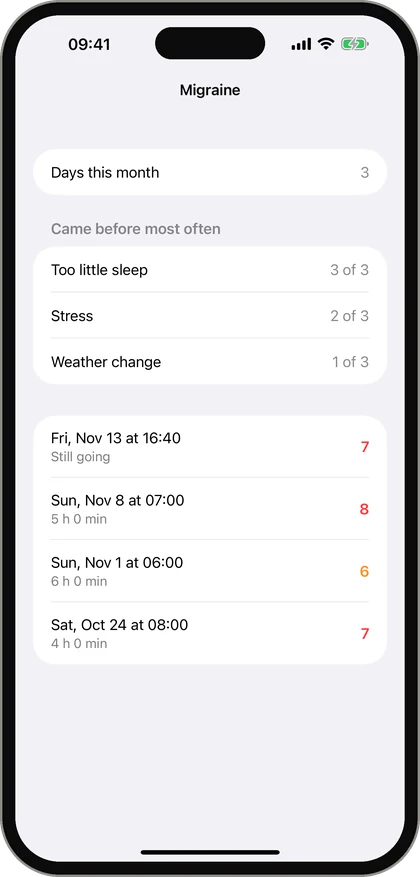
If you want to start with the basics first, read what to write in a headache diary.
Questions people ask
What are common migraine triggers?
People with migraine often name too little or too much sleep, stress or the let-down after stress, skipped meals, not drinking enough, alcohol, bright light, strong smells, changes in the weather and, for many women, their period. Which of these matter differs from person to person.
How do I find my migraine triggers?
Tick the same short list of possible triggers before every attack for two to three months, then count how often each one was there. Compare that with how often it happens on days without an attack.
Does a trigger diary prove what causes my migraines?
No. It shows what was often there before an attack. Some things that look like triggers are early signs of the attack itself, so discuss the counts with your doctor before you change anything important.
How long does it take to see a pattern?
It depends on how often you have attacks. With a few attacks a month, two to three months usually gives enough entries to see whether something keeps coming up.
This article is general information about keeping a record. It is not medical advice and does not replace your doctor. If your pain is new, sudden, severe or changing, see a doctor; in an emergency call your local emergency number.