People who live with pain for a long time often use three words that a simple diary has no place for: their usual level, a flare-up, and breakthrough pain. If your pain is "always a 2" and sometimes a 7 for four days, a diary that only asks "pain today, yes or no" hides most of the story. This guide explains the words and shows a simple way to record all three.
Three words, three different things
- Usual level, or baseline. The pain you have on an ordinary day. For some people that is 0. For others it is a steady 2 or 4 that never fully goes.
- Flare-up. A time when the pain is clearly worse than your usual level. It can last hours, days or weeks, and then settles back.
- Breakthrough pain. A short, sharp rise on top of pain that is otherwise kept steady, often with regular medicine. It comes on fast and usually passes within minutes to an hour or so.
Doctors ask about these separately, because they can call for different answers. A diary that keeps them apart saves you from explaining it all from memory.
Write your usual level down once
You do not need an entry for every ordinary day. Write your usual level at the top of the diary, with a few words on what it allows: "Usual: 2 to 3. I work and walk, but I do not lift." Check it once a month and change it if it has moved. A usual level that creeps up over several months is worth telling your doctor about, and it is easy to miss without a note.
Record a flare-up as one entry with a start and an end
A flare-up of four days is one event, not four. Write down:
- the day and time it started
- the strongest point, as a number from 0 to 10
- what you could not do during it
- what you tried, and whether it helped
- the day it was back to your usual level
On the worst days, the start and a number are enough. The rest can wait until it has settled. If something was different in the days before, such as more activity than usual, a bad night, an illness or a stressful week, note it as a word. Read such notes as things to mention, not as proof of a cause.
Note short spikes with the time
For breakthrough pain, the time matters most. Write down when it came, how strong it was, how long it lasted, and when you last took your regular medicine. If the spikes often come shortly before the next dose is due, or always with the same movement, your doctor will want to know. Do not change doses yourself because of a diary.
What the diary shows after a few months
- how many flare-ups you had, and how long they lasted
- how much time lay between them
- whether your usual level has changed
- how often short spikes came, and at what time of day
"Three flare-ups in two months, each about four days, usual level up from 2 to 3" is a sentence a doctor can work with. It is also a sentence nobody can produce from memory.
How Pain Tracker does it
In Pain Tracker, the Family Health app, a headache, migraine or pain entry stays open as "still going" until you tap End, whether that is after an hour or after several days. The app then works out the length. A short spike is its own entry with its own time. The journal lists every entry with its length and strength, so flare-ups stand out.
Coming in version 2.0. The screens below are from version 2.0, which is on its way to the App Store. Update the app once it appears.
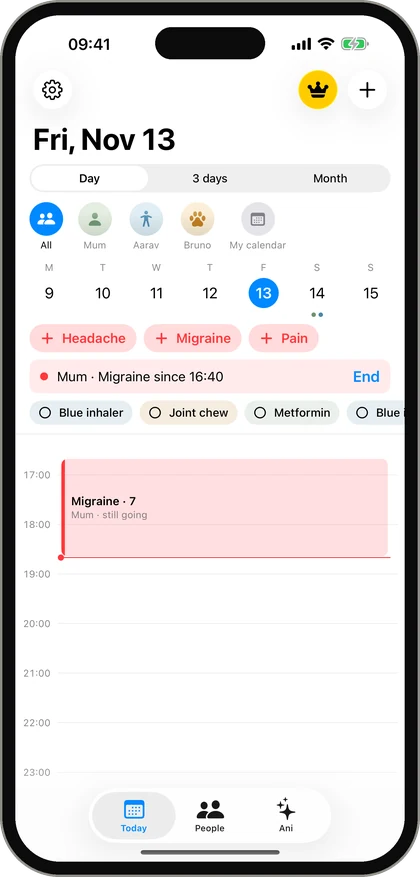
The app has no separate field for a usual level yet. Pain Tracker keeps a record and does not diagnose. For the basics, see how to keep a pain diary.
Questions people ask
What is a pain flare-up?
A flare-up is a time when long-term pain is clearly worse than your usual level. It can last hours, days or weeks, and then settles back to where it was before.
What is breakthrough pain?
Breakthrough pain is a short spike of stronger pain that comes on top of pain which is otherwise kept steady, often with regular medicine. Tell your doctor if it happens often.
What is baseline pain?
Baseline pain is the level of pain you have on an ordinary day, when nothing special is going on. Knowing it makes flare-ups easier to describe.
How do I describe a flare-up to my doctor?
Say when it started and ended, how strong it was compared with your usual level, what you could not do during it, and what you tried. Dates from a diary make this much easier.
This article is general information about keeping a record. It is not medical advice and does not replace your doctor. If your pain is new, sudden, severe or changing, see a doctor; in an emergency call your local emergency number.