Ask people who live with pain which tracker they would recommend, and the answers differ. One thing comes up again and again, though: the best pain diary is the one you are still using next month. A diary with every detail for nine days is worth less than three lines a day for nine weeks.
This guide is about keeping a pain diary going. It covers what to write down, what you can leave out, and how to turn it into something a doctor can read in a minute. It works on paper, in a notes app or in a pain tracker app.
Why pain diaries get given up
We read through long discussions in chronic pain communities before writing this. People there rarely stop because they lose interest. They stop because the diary asks too much on the days when they have the least to give. A check-in with twelve questions feels like homework, and on a bad day it does not get done. After a few empty days the diary feels broken, and it is dropped.
The second reason is that nothing comes back. If the entries only go in, and no pattern or summary ever comes out, writing them down starts to feel pointless.
So a diary that lasts needs two things: it must cost almost nothing on a bad day, and it must give you something back.
Start with three things
For the first two weeks, write down only this:
- When it started. The date and the time, as closely as you know them.
- How strong it was. A number from 0 to 10 is enough.
- How long it lasted. Or the time it ended, which gives the same answer.
That is a diary. From these three things alone you can later count your pain days in a month, see whether they are getting more or fewer, and see whether they are getting longer or stronger. Those are the first things most doctors ask about.
Use your worst day as the test
Picture your worst day of the last month. Could you have made the entry on that day? If the honest answer is no, the diary is too heavy, and it will fail exactly when the entry matters most.
Make the bad-day entry as small as you can. One tap, one line, one mark on a calendar. Details can be added the next day, when you feel able to. An entry that says only "migraine, started around 4 pm" is far more useful than no entry.
Add one detail at a time
Once the three basics have become a habit, add a detail, but only one you expect to use. Good candidates are:
- Where it hurts. The same spot every time, or a different one?
- What came before. Too little sleep, a skipped meal, a long day at a screen, stress, a change in the weather.
- What you tried and whether it helped. Rest, water, a dark room, a medicine, warmth or a cold pack.
Keep each of these to a tick or a word. You do not have to record every symptom every day. Some people only write down new symptoms, or only their best and worst days, and that is a fair way to keep the diary light.
A list of what came before is a count, not a cause. If "too little sleep" was ticked before six of eight headaches, that is worth showing to your doctor. It does not prove that sleep caused them.
Mark the good days too
A diary that only holds bad days cannot tell a pain-free day from a day you forgot to write. If pain-free days are rare for you, they are worth recording in their own right, and a short note on what was different can be as useful as any entry about pain.
A simple way to do it: at the end of a day without pain, make a mark. Nothing else is needed.
Say what the number means
A pain number on its own is easy to misread. Your 7 and another person's 7 are not the same, and a doctor hearing "seven" has little to go on. People in pain communities describe this often: they give a number and feel that it did not land.
What helps is to put a few words beside the number that say what the pain stopped you doing:
- "6, left work at noon."
- "8, could not look at light, lay down for four hours."
- "3, carried on, but skipped the walk."
These few words turn a number into something another person can picture. They also show changes that the number hides, such as the same strength of pain costing you more of your day than it used to.
Look back before the appointment
This is where the diary pays you back. Before an appointment, do not hand over the whole diary. Read it yourself and put the last one to three months on one page:
- how many days with pain, and whether that is more or fewer than before
- the usual strength and the usual length
- where it usually is
- what was most often noted before it started
- what you tried, and how often it helped
- how many days you took a painkiller
A single page like this is more likely to be read than thirty pages of entries. It also saves you from rebuilding the last weeks from memory in the waiting room, and from telling the whole story again each time you see someone new.
App or paper?
Both work, and paper has real fans. One person in a chronic pain community put it this way:
"I found pen and paper more reliable than an app."
A member of a chronic pain community on Reddit
Paper is always there, needs no battery and asks no questions. Its weak point is the looking back: counting days and working out averages by hand is slow, so it often does not get done.
An app does the counting for you, keeps the time and the length without your help, and can build the one-page summary. Its risk is the opposite one. An app with too many fields becomes the homework this guide warns about. If you try one, apply the worst-day test before anything else. If a single entry takes more than a few seconds, look for another.
How Pain Tracker does it
We build Pain Tracker, the Family Health app for iPhone, iPad and Apple Watch, around the ideas above.
Coming in version 2.0. The screens below are from version 2.0, which is on its way to the App Store. Update the app once it appears.
- One tap when it starts. Tap Headache, Migraine or Pain and the entry is saved with the time. Tap End when it is over and the app works out the length.
- Details later, as ticks. Where it hurts on a picture of the head or body, strength from 0 to 10, what came before and what helped.
- A page for the doctor. The summary counts pain days, the usual strength and length, what was ticked most often before, and painkiller days, over 7 days, 30 days or 3 months.
- The whole family. Each person has their own journal, so a parent can keep the diary for a child or for their own mother or father.
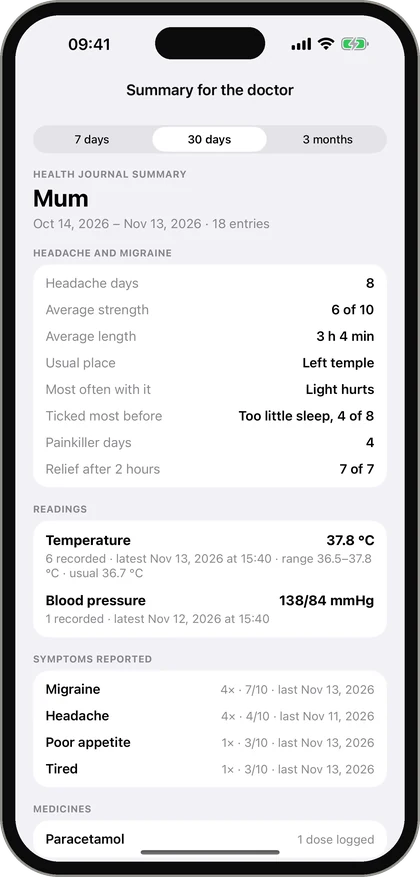
Pain Tracker keeps a record. It does not diagnose, and it does not say what caused a headache.
Questions people ask
What should I write in a pain diary?
Start with when the pain began, how strong it was from 0 to 10, and how long it lasted. Later you can add where it hurt, what came before, what you tried, and a few words on what the pain stopped you doing.
How long should I keep a pain diary before an appointment?
Four weeks already shows how often pain comes and how long it lasts. Two to three months makes it easier to see whether things are changing. Ask your doctor what period they would like to see.
Do doctors read pain diaries?
That varies. A short summary on one page is much more likely to be read than a full diary, so bring the summary and keep the full diary with you in case questions come up.
Is a paper pain diary as good as an app?
For writing things down, yes. An app saves time when you look back, because it counts the days and works out the averages for you. The better choice is the one you keep using.
This article is general information about keeping a record. It is not medical advice and does not replace your doctor. If your pain is new, sudden, severe or changing, see a doctor; in an emergency call your local emergency number.