Pain is hard to put into words, and the appointment is short. Many people leave feeling that they did not get across how bad it is. It helps to know in advance which things a doctor is listening for and to have words ready for each. This guide goes through them.
Where it is
Be as exact as you can, and point if that is easier. "My head" is less useful than "behind my left eye and in the left temple". Say whether it stays in one place, moves, or spreads, for example from the neck up to the back of the head, or from the back down one leg.
How it feels
Different kinds of pain feel different, and the word you choose is a real clue for the doctor. Common words are:
- Throbbing or pulsing: it beats, often in time with your pulse.
- Pressing or tight: like a band or a weight.
- Stabbing or sharp: sudden, like a knife or a needle.
- Dull or aching: steady, deep, hard to pin down.
- Burning: hot, like a scald or a sunburn.
- Shooting or electric: it runs along a line, like a shock.
- Cramping: it grips and lets go.
- Tingling or numb: pins and needles, or less feeling than usual.
Pick the one or two that fit best. If none does, a comparison works as well: "like a tight helmet", "like a toothache in my hip".
How strong it is
Give a number from 0 to 10, and add what stands behind it. See our guide to the 0 to 10 pain scale for how to make your number mean the same thing every time.
When it comes and how long it lasts
- When did it first start, and was there an event, such as a fall or an illness?
- Is it always there, or does it come and go?
- How long does one bout last: minutes, hours, days?
- How often does it come: every day, a few times a month?
- Is there a time of day when it is worse?
These are the questions people find hardest to answer from memory. A few weeks of dated notes answer them for you.
What makes it better or worse
Say what changes the pain: movement, rest, sitting, lying down, light, noise, eating, warmth, cold. Say what you have tried, including things you bought yourself, and whether each helped a lot, a little or not at all.
What comes with it
Mention anything else that shows up with the pain, such as feeling sick, dizziness, light hurting, weakness, numbness, fever or trouble sleeping. Things that seem unrelated can matter.
What it stops you doing
This is the part most often left out, and it is the part that makes pain real to a listener. Work, sleep, walking, lifting, driving, cooking, looking after children: say which of these the pain has taken from you, and how often. "I have missed six days of work this month" is hard to wave away.
Bring it written down
Write the points above on one page before the appointment, or bring a diary summary. It keeps you from forgetting half of it in the room, and a dated record is harder to doubt than a memory. Our guide on what to bring to a pain appointment has a checklist.
How Pain Tracker does it
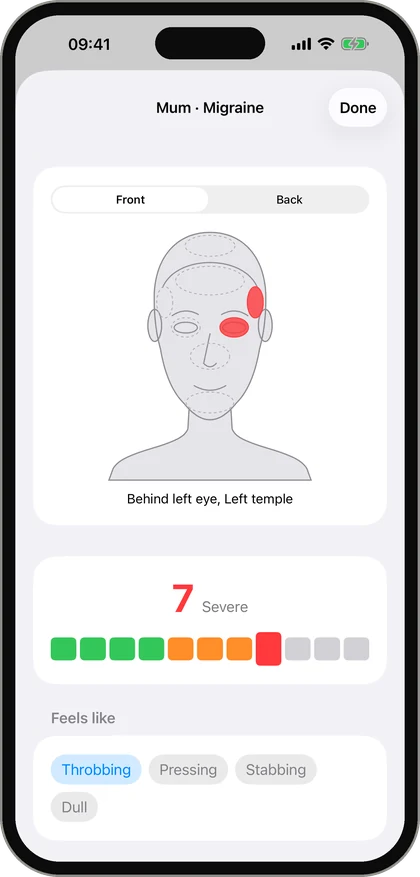
In Pain Tracker, the Family Health app, you mark the place on a picture of the head or body, set the strength, and tick how it feels: throbbing, pressing, stabbing or dull. The app names the place for you, such as "behind left eye, left temple", and the doctor summary shows the usual place and the usual strength.
Coming in version 2.0. The screens below are from version 2.0, which is on its way to the App Store. Update the app once it appears.
Pain Tracker keeps a record. It does not diagnose.
Questions people ask
What words can I use to describe pain?
Common ones are throbbing, pressing, stabbing, dull, aching, burning, shooting, cramping, tingling and electric. Choose the one or two that fit best and use the same words each time.
How do I explain my pain so that it is taken seriously?
Be specific. Give dates, a number from 0 to 10, how long it lasts, and above all what it stops you doing. A written record of the last weeks carries more weight than a description from memory.
What should I tell my doctor about my pain?
Where it is, how it feels, how strong it is, when it started, how long it lasts, how often it comes, what makes it better or worse, what comes with it, what you have tried, and what it stops you doing.
What if I cannot find the right words?
Point to the place, compare the feeling with something familiar, and describe what you could not do. A picture with the place marked and a few diary entries can say a lot without many words.
This article is general information about keeping a record. It is not medical advice and does not replace your doctor. If your pain is new, sudden, severe or changing, see a doctor; in an emergency call your local emergency number.