People with long-term pain change doctors more often than they would like: a move, a referral, a practice that closes, a doctor who did not listen. Each time, the story starts again from zero, and it has to fit into a first appointment. A one-page pain history lets you hand the story over instead of telling it. This guide shows what to put on it.
Why one page
A new doctor has a few minutes to read before or while they talk to you. A folder is not read in that time. One page is. It also puts you in charge of what is said first, and it keeps you from forgetting the important part when you are nervous.
What goes on the page
- Who you are. Name, date of birth, date of the summary.
- The pain in one sentence. "Pain in the lower back and left leg since March 2023, after a fall."
- How it is now. Usual strength, how often it is worse and for how long, where it is, how it feels.
- How it has changed. Better, worse or the same over the last year.
- What it stops you doing. Work, sleep, walking, lifting, driving.
- Diagnoses and tests so far. What was found, by whom, in which year. Include tests that found nothing.
- What you have tried. Each medicine and treatment, for how long, and whether it helped, did nothing or caused problems.
- What you take now. Every medicine with the dose, including ones for other things and ones you buy yourself.
- Allergies and other conditions.
- What you hope for from this appointment. One or two questions.
A template you can copy
- Summary for Dr …, 13 November 2026. Anna Example, born 4 May 1980.
- Main problem: migraine since 2019, more frequent since spring 2026.
- Last 3 months: 8 headache days a month, usual strength 6 of 10, about 5 hours each, mostly left temple, light hurts. 4 painkiller days a month.
- Effect: 3 days of work missed last month.
- Tests: MRI of the head 2021, no findings (report attached).
- Tried: tablet A 2019 to 2021, helped at first; tablet B 2022, stopped because of side effects; physiotherapy 2023, no change.
- Now: tablet C when needed; blood pressure tablet daily.
- My questions: Why more often now? Is there something to prevent them?
The names here are made up. Write yours in your own words; it does not need to sound medical.
Take care over the list of what you tried
This is the part new doctors ask about most, and the part people most resent having to repeat. A written list ends the "have you tried…" round quickly and shows that you have done your share. See keeping a list of what you have tried.
What to bring with it
- two copies of the page, one to hand over and one for you
- reports of scans and tests, and letters from earlier doctors
- your medicine list, or the boxes
- your diary of the last one to three months, in case of questions
More on the appointment itself in what to bring to a pain appointment.
How Pain Tracker does it
The "How it is now" part of the page is what Pain Tracker, the Family Health app, writes for you. The doctor summary shows the last 7 days, 30 days or 3 months: headache days, average strength and length, the usual place, what was ticked most often before, painkiller days, readings and medicines. With Family Health Pro it can be exported as a PDF. Scans of reports and letters can be kept in the app with the person they belong to.
Coming in version 2.0. The screens below are from version 2.0, which is on its way to the App Store. Update the app once it appears.
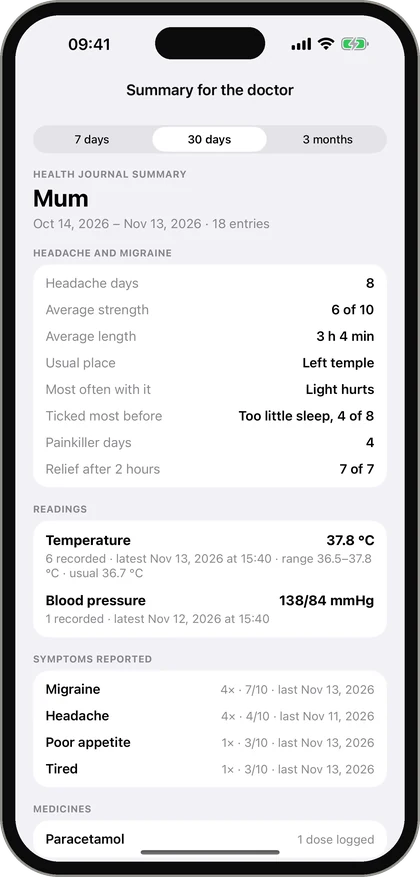
The longer history, with years, tests and earlier treatments, is still yours to write. Pain Tracker keeps a record and does not diagnose.
Questions people ask
What should a pain history include?
When and how the pain started, where it is and how it feels, how it has changed, what makes it better or worse, tests and diagnoses so far, everything you have tried and how it went, your current medicines, and what the pain stops you doing.
How long should a medical history summary be?
One page for the summary. Bring the details, such as test reports and a medicine list, as separate sheets behind it.
Should I bring old test results to a new doctor?
Yes, if you have them: reports of scans and blood tests and letters from other doctors. It can save repeat tests. Ask your old practice for copies in good time.
What if I cannot remember when everything happened?
Give the year or the season, and say that it is a rough date. From today on, a diary will keep the dates for you.
This article is general information about keeping a record. It is not medical advice and does not replace your doctor. If your pain is new, sudden, severe or changing, see a doctor; in an emergency call your local emergency number.