People who keep a pain diary tell two kinds of stories. In one, the doctor asked for the diary and went through it with them. In the other, the diary was pushed back across the desk after a glance. It is a fair question whether the work is worth it. The honest answer is that it varies, and that much of the difference lies in what exactly you put on the desk.
Why a full diary often is not read
An appointment may last ten or fifteen minutes. Sixty days of handwritten entries cannot be read in that time, let alone counted. A doctor who puts such a diary aside is usually not doubting you. They cannot use it in the form it is in.
What a doctor can use is the answer the diary holds: how often, how strong, how long, what was taken, what changed. Your job is to bring that answer, and the diary as its proof.
Five ways to make it usable
- Bring one page. Count your pain days, the usual strength and length and your painkiller days for the last one to three months, and write them at the top. Our checklist shows what to count.
- Lead with numbers. "Nine headache days in October, six in September" is read in a second. A paragraph is not.
- Show the change. Put this period beside the one before, or mark the day a new medicine started. Whether something changed is the question most appointments are about.
- Say what it cost you. Days of work missed, nights without sleep, things you could not do.
- Put it on paper. A printed page can be read at a glance, written on and kept in your file. A phone passed across the desk cannot.
Ask what they want to see
At the end of an appointment, ask: "What would you like me to record until next time?" Some doctors want painkiller days above all. Others want the strength every day for two weeks after a change. If you bring what was asked for, it will be looked at.
If it is still not read
The diary has done part of its work anyway. You can answer "how often?" with a number and a date range without guessing. Your account is the same at every visit and with every doctor. And you can see for yourself whether things are changing, which matters on the days when it is hard to tell.
A dated record is also harder to doubt than a memory. People who have felt disbelieved often say that bringing dates changed the tone of the talk. A diary cannot promise that, but it gives you firmer ground to stand on.
How Pain Tracker does it
Pain Tracker, the Family Health app, builds the one page from your entries. The doctor summary shows headache days, average strength and length, the usual place, what was ticked most often before, painkiller days and how often relief followed, for 7 days, 30 days or 3 months, with your readings and medicines below. With Family Health Pro you can export it as a PDF to print or send ahead.
Coming in version 2.0. The screens below are from version 2.0, which is on its way to the App Store. Update the app once it appears.
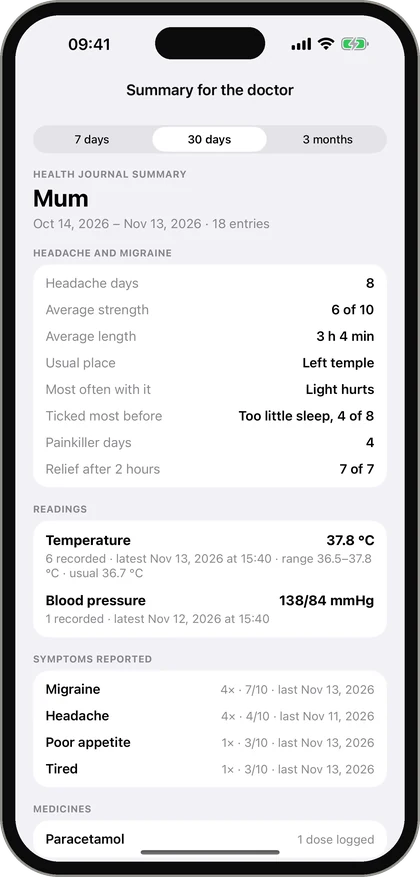
Pain Tracker keeps a record and does not diagnose. To start the diary itself, read how to keep a pain diary you will actually keep.
Questions people ask
Do doctors actually look at pain diaries?
It varies. Many headache and pain doctors ask for one. Few have time to read weeks of entries in an appointment, so a one-page summary is far more likely to be used than the full diary.
What do doctors want to see in a pain diary?
How many days with pain, how strong and how long, how many days a painkiller was taken, what was tried and whether it helped, and what the pain stops you doing.
Should I show my doctor the app on my phone?
A printed page or a PDF is easier. A doctor can read it at a glance, write on it and put it in your file. Keep the phone ready for questions about single days.
What if my doctor does not want to look at it?
Say the main numbers out loud instead, and ask what they would like you to record until the next visit. The diary still helps you answer their questions exactly.
This article is general information about keeping a record. It is not medical advice and does not replace your doctor. If your pain is new, sudden, severe or changing, see a doctor; in an emergency call your local emergency number.