"Have you tried heat? Physiotherapy? This tablet?" People who have lived with pain for years know these questions by heart, and many are tired of them. One person in a pain community summed it up as having done all the things. The questions are not going to stop, because each new doctor needs the answers. What you can change is how long it takes to give them. A written list does it in a minute, and it shows how much you have already done.
What goes on the list
Everything you have used for the pain, in three groups:
- Medicines. Prescribed ones and ones you bought yourself, including creams and patches.
- Treatments. Physiotherapy, injections, acupuncture, massage, operations, courses and programmes.
- Things you do yourself. Heat, cold, rest, a dark room, stretching, a certain pillow, changes to food or sleep.
What to note for each
- What it was, with the dose or how often.
- From when to when. The year is enough for older ones.
- How it went: helped a lot, helped a little, did nothing, or made things worse.
- Problems. Side effects, or reasons you could not keep it up.
- Why you stopped. It ran out, it stopped working, the side effects, the cost, the doctor's advice.
One line each. It can look like this:
- Tablet A, one when needed · 2019 to 2021 · helped a lot at first, then less · no problems · stopped working
- Physiotherapy, 12 sessions · spring 2023 · no change · none · course ended
- Heat pad on the neck · since 2022 · helps a little · none · still using
Finding out whether something helps
For things you use when the pain comes, make a small note each time: what you used, and how you felt about two hours later. Better, a little better, the same. After ten uses you can say "relief followed 7 times out of 10", which is much firmer than "I think it helps".
For things you take or do every day, look at your diary. Compare the pain days, the usual strength and the painkiller days in the month before you started with the months after. Mark the start date clearly in the diary so that the two can be told apart.
A diary shows what happened after something. It cannot prove that the treatment was the reason. Take the counts to your doctor, and do not stop or change a prescribed medicine on your own.
Keep it up to date
Add a line when something new starts, and finish the line when it ends. Keep the list where your diary is, and bring a copy to every first appointment. With your pain history on one page it is the most useful thing you can hand to a new doctor.
How Pain Tracker does it
Pain Tracker, the Family Health app, covers the two parts that are hardest to do by hand. Regular medicines are kept with their daily doses and ticked as taken. For each headache, migraine or pain entry you can tick what helped, and note how you were after two hours. The doctor summary then counts painkiller days and how often relief followed.
Coming in version 2.0. The screens below are from version 2.0, which is on its way to the App Store. Update the app once it appears.
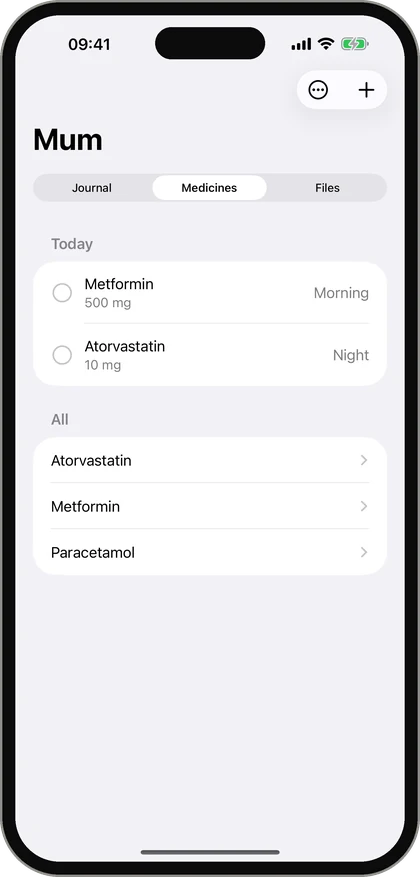
The list of everything you tried in earlier years is still yours to write; the app does not hold it yet. Pain Tracker keeps a record and does not diagnose.
Questions people ask
What should I put on a list of treatments I have tried?
The name, the dose or how often, from when to when, whether it helped a lot, a little or not at all, any problems it caused, and why you stopped. Include medicines, therapies and things you do at home.
Why do doctors keep asking what I have tried?
They need to know what is left to try and what must be avoided. A written list answers the question in a minute and saves trying the same thing twice.
How do I know whether something helped?
Note how you felt about two hours after using it, each time. After several uses you can count how often relief followed. For daily treatments, compare your pain days before and after you started.
Should I list things that did not work?
Yes. What did not help, and what you could not tolerate, is as useful to a doctor as what did.
This article is general information about keeping a record. It is not medical advice and does not replace your doctor. If your pain is new, sudden, severe or changing, see a doctor; in an emergency call your local emergency number.